Wednesday, 19 March 2014

Recap Wednesday - AARRRGGGHHH!

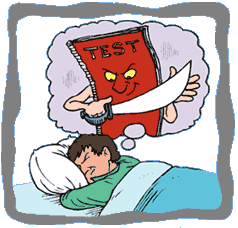
No updates yet this week, but that's ok, we know you're worried about the big progression test this Thursday. Actually, we need to talk about recaps, so it works out well for us. I think we're all working too hard and trying to retell what happened in the class in general instead of thinking about how we felt in the class and how we thought about it or what we thought was useful. We're probably doing a lot of possibly not-so-valuable work to avoid doing some actually-could-be-quite-valuable work. So, for one night only, please find my recap of today's class as it was for me as a teacher - not a list what we did, but instead how I felt and thought about it. 


Today I was quite excited about the class because we were talking about 2 of my favourite subjects - stories and sci-fi! We started by finding out that nobody but me had ever heard of Ray Bradbury, which was surprising. I thought he might be better known than that, but I guess not. Anyway, I told you guys about him and set you off reading about The Illustrated Man. You seemed to enjoy it, which was good, but I was disappointed that I had the wrong audio on my PC and wasted a bit of time trying to find the right one. I don't think you noticed too much, but I wasn't happy with myself. 

Then I got you to do what's known in the business as a running dictation, where you were trying to recreate the story from the wall on the page. That was good from my point of view as everyone was involved and looked like they were having fun - and we also found out what pronunciation problems we might have (watch out for this weekend when I'll be putting up a post about how/where to practice this online). Then I went for a coffee, Americano, 4 sugars - yes, that's what's in the cup. The good news is that tomorrow's coffee is free, because I've saved up enough points. 

After the break we set you to creating your own stories based on the illustrated man's tattoos. I showed you a little trick about story structure and told you about Kurt Vonnegut, another of my favourite authors. The ideas you came up with for your stories would have made him proud and I'm very excited to see the finished products on Monday. I was really impressed with how well you planned out your work, and I think you'll notice a big difference in how easy it is to write in English once you have a good, solid plan. 

Anyway, tomorrow is your big test. We start at 9 sharp. Writing ends at 9:40 - perhaps it might be an idea to make a plan before you start answering the question. (:


Wednesday, 12 March 2014

Paddy's Day Webquest!

Class Schedule:

1. Paddy's Day Video - 9 - 9:30
2. Research Topic - 9:30 - 10:15
3. Share information in groups - 10:15 - 10:45
4. Prepare presentation - 10:45 - 11:45
5. Presentations 11:45 - 12:30
6. St. Patrick's Day Song 12:30 - 13:00


1. Paddy's Day Video - 9 - 9:30

Well we're almost there, the big celebration is this weekend, but first we need to find out a bit about what we're celebrating and what it means. Let's start with a video. Grab your partner and click on this link - have a look at the video: Paddy's Day Video


Finished watching? Ok, now answer these questions:

What is St. Patrick's Day a celebration of?

When does the story of St. Patrick begin?

How long was St. Patrick kept as a slave?

What was his second vision?

What did St. Patrick write about in his autobiography?

What two myths exist about St. Patrick?

Which one is real? Which one is not? Why not?

Why does the holiday fall on March 17th?

What religious time does St. Patrick's Day fall during?

Why was it unusual for Irish people down a pint or two of ale on St. Patrick's day?

Where and when was the first St. Patrick's Day parade?

Which is the largest St. Patrick's Day parade?

Where did the Irish emigrate to during the potato famine?

What colour should you wear on St. Patrick's Day in the U.S.A.?

What meal is traditional for St. Patrick's Day in the U.S.A.?

Why is St. Patrick's Day celebrated so widely in the U.S.A.?

Feel free to watch the video again if you're not sure of any answers. Make notes of any new vocabulary. Did you notice any parts that were difficult to understand? What did they say? Why do you think it was difficult?

2. Research Topic - 9:30 - 10:15

St. Patrick is just one of the legendary characters from Irish History - the myth is bigger than the man. There are many more legendary characters from Ireland's mythology. Let's choose another one and research them. Find out as much information as you can about them and make notes about them. You'll need those notes to tell your group all about them before the break and to help you make a presentation later.

1. With your partner, choose one of the following characters, or choose another one you know if you like. 

The Banshee, Cú Chulainn, Queen Maedbh, Fionn MacCumhaill, Oisín and Niamh, Diarmuid and Gráinne, The Children of Lir, Deirdre of the Sorrows. 

2. Make a list of questions you would like answered about that person (use: who, what, where, when, why, how).

3. Search for the answers to those questions. 

4. Make notes on the answers.

5. Decide if you have enough information. Make more questions and find their answers if you don't. 

6. Check your notes and think about how you can use relative clauses to explain them to someone else. 

3. Share information in groups - 10:15 - 10:45


It's time to check-in and see how the rest of the group are doing. Meet one person from all the other pairs in a big group. Tell the group about your character and answer any questions they have - Do you have all the information? Make a note if you don't. Ask questions about the other characters. 

4. Prepare presentation - 10:45 - 11:45

Quick, before the break - let's get planning our presentations. 

1. 10:45 - 11:00 Rejoin your partner. Do you need more information? Look at your notes from the group conversation. Decide what you need to do for your presentation. Do you need to find pictures? Do you want to make a slideshow? Do you need to write some notes about what you're going to say? Who's going to do what jobs? Decide how you're going to get your presentation ready in 30 minutes after the break. 

2. 11:00 - 11:15 Phew. Take a break! You deserve it. 

3. 11:15 - 11:45 Get working on your presentation. You have 30 minutes to get it ready. Try to practise what you're going to say at least once first. 

5. Presentations 11:45 - 12:30

Sweat it out until your turn, or relax and enjoy the other stories. Ask questions if you don't understand part of the story. Can you hear any relative clauses in what other students say? Are there any in your presentation? Which story is your favourite? Why? 

6. St. Patrick's Day Song 12:30 - 13:00

I'll post this here on the day when the presentations are finished. It's a classic, so I hope you're ready!


Tuesday, 11 March 2014

Tuesday Recap

Guest post by our classmate Angel Quesada - Thanks Angel - Liam.

Hello guys,

This Tuesday we started the class talking about words that English has adopted or modified from another language, which was really interesting to know about.

While many words enter English as slang, not all do. Some words are adopted from other languages; some are mixtures of existing words, and some are new made of roots from dead languages.

For Example:
  • Husband: The term husband refers to Middle English huseband, from Old English hūsbōnda, from Old Norse hūsbōndi (hūs, "house" + bōndi, būandi, present participle of būa, "to dwell", so, etymologically, "a householder").

  • Alarm: From Old French alarme (14c.), from Italian all'arme "to arms!" (Literally "to the arms"). An interjection that came to be used as the word for the call or warning.

  • Jean: From Middle French jean fustian "fustian (a type of twilled cotton cloth) of Genoa," the city in Italy, from Old French Jannes "Genoa," from Latin Genua.

  • Genuine: From Latin genu "knee," from a supposed ancient custom of a father acknowledging paternity of a newborn by placing it on his knee.

  • Orange: From Old French orange, orenge, from Medieval Latin pomum de orenge, from Italian arancia, originally narancia (Venetian naranza), alteration of Arabic naranj, from Persian narang, from Sanskrit naranga-s.

  • Tennis: Most likely from Anglo-French tenetz "hold! receive! take!," from Old French tenez, imperative of tenir "to hold, receive, take" (see tenet), which was used as a call from the server to his opponent. 
In addition, we talked about Compound words with Prefixes and through the union of two words. Also English words that have certain patterns of stress which you should observe strictly if you want to be understood. 

Here are some examples for compound words (Blend):

  • camcorder (camera + recorder)
  • chexting (cheating + texting)
  • clash (clap + crash)
  • cosmeceutical (cosmetic + pharmaceutical)
  • docudrama (documentary + drama)
  • electrocute (electricity + execute)
  • emoticon (emote + icon)

By the way, the definition for blend is:
A word formed by merging the sounds and meanings of two or more other words or word parts.

The best way to learn English stress is to listen to audio materials and to repeat them after the speaker. Generally, common English nouns, adjectives, and adverbs are more often stressed on the first syllable than on any other syllable. Verbs with prefixes are usually stressed on the second syllable. English words can't have two unstressed syllables at the beginning of the word; one of these syllables will be stressed. 

If a word has four or more syllables, there are usually two stresses in it: primary stress (strong stress) and secondary stress (weak stress). Also, secondary stress may be present (in addition to primary stress) in shorter words in the syllable in which the vowel remains long and strong.

To finish the class, Liam surprised us with a game where we had to write a verb, a thing and a well-known person, we formed 4 groups and then we tried to guess what was written on each piece of paper. It was really funny because some of the words were really rare. It was a good game to practice our English listening and speaking. 

Finally I recommend this website in order to practice your English, it's a really good one.


http://www.ego4u.com/

Monday Recap

Guest post by our classmate Ilchmaa Erdene - Thanks Ilchmaa - Liam.

Hello guys,

This Monday, we started the class with 5 riddles on the board :
A place where young children go to school – (Kindergarten)
A person who cooks food professionally – (a chef)
A nap which people take during the day in hot countries - (siesta)
A food which is commonly eaten in Italy – (pasta)
A type of entertainment where people sing popular songs – (karaoke)

These sentences introduced today's lesson which talked about the relative pronouns,         ''who, whose, whom, which, what, that ''.

We also learned some foreign words used in the English language such as muesli (german) shampoo (hindi), igloo (inuit), algebra (arabic), robot (czech), macho (spanish), tycoon (japanese), graffiti (italian) and yogurt (turkish).

There are two ways to use relative pronouns : Non Defining Relative Clause (N.D.R.C) and Defining Relative Clause (D.R.C). You can find below a resume of relative clauses with some examples that we saw in class.

Non-Defining Relative Clause - N.D.R.C:

NDRC's give extra or non essential information. They use commas before and after. DON'T use ''that'' for NDRC.
E.g I had a cake for dessert, which was a great idea. In this case, ''which'' is used to give a comment or opinion on the previous phrase and not to define.

Defining Relative Clause – D.R.C 

D.R.C's give essential information about a subject.
  • WHO is used to define a person.
    The woman who lives next door is a drug addict. We can use ''that'' instead of ''who'' and ''which''.
  • WHOSE means 'of who' or 'of which'.
    There's my neighbour whose wife was arrested for shoplifting.
  • WHOM is used after a preposition.
    That's the man to whom I was speaking earlier. We can also say 'That's the man who I was speaking to earlier'.
  • WHAT is used to mean 'the thing' or 'things'
    What I like best about my teacher is his good looks, immense intelligence and astounding sense of humour.
    She told me what she had seen.
D.R.Cs can define the object. E.g. James is the man who I met at the party. When a D.R.C describes an object, we can remove the relative pronoun. E.g That's the shop (which) I told you about.

When do we use Where or Which 

There's a little difference between D.R.C where and which.
E.g There's the hotel where I stayed
There's the hotel which I stayed in
We DON'T SAY There's the hotel where I stayed in.
That's the building where I live
That's the building which I lived in
That's the building in which I lived (formal english)

So we have 3 possibilities to write the same sentences in different ways, more formal or less formal.
Another example with 'whom' and 3 ways to write the same sentence.
  1. The police officer to whom I spoke was working on the reception desk
  1. The police officer who I spoke to was working on the reception desk.
  2. The police officer I spoke to was working on the reception desk
Phrase N°1 with ''to whom'' is formal English, you need to know how to use it if you want to take a Cambridge exam. The phrases N° 2 and 3 are informal and spoken English.

We learned that the Prime Minister in Ireland is called ''An Taoiseach' and that he says Ireland is the best country to do business in. But English teachers wish he would say Ireland is the best country in which to do business.

We also did many exercices to put it all in our mind. This is very important to know the relative pronouns because people use them very often and we should use them more often. For example, we should say 'The movie I saw yesterday was amazing' instead of 'I saw this movie, it was amazing'.

That's it, see you tomorrow.

Ilchmaa

Friday, 7 March 2014

Me, You and Your Mistakes

Mistakes and errors. Errors and mistakes. Why do we say "She have" when we know it's "She has"? Why do we confuse the order of words, "Usually, I don't go out on Fridays" instead of "I don't usually go out on Fridays"? Why do we make mistakes and what can we do about them? That's a question that I have to ask myself every day as I try to help you improve your skills in English. It's a tough thing to do, because we need to find a balance between making sure you're speaking or writing correctly, but also making sure you feel confident and comfortable in the language. To that end, I want to share with you some of the techniques, and the research behind them, that I use in the class to help you. 

The first thing to decide is if someone has made a mistake or an error. But they're synonyms, you might say, there's no difference between them. Well, for us English teachers they are very different things. A mistake, for us, is when you know the correct form but for some reason you don't produce it properly on isolated occasions - we'll talk about those reasons a little later. An error is when you don't know the correct form, or you haven't learned it yet - these normally cause communication problems. Let's look at the two types individually after the jump.


Thursday recap

Guest post by our classmate Sendai Zea - Thanks Sendai - Liam.

Hello guys!

This Thursday we started the class talking about advertisements. It was a good opportunity to talk about fraudulent advertisements.

In addition, the grammatical skill that we improved was linkers to express “contrast” or “purpose”. They’re so useful for writing papers, expressing our own opinion and having a fluent conversation. Personally, I think that most of them are well-known, but frequently we don’t remember to use them in our day-to-day English. 

In fact, we revised the following:

TO EXPRESS CONTRAST:

According to the structure that they follow, we can divide in two groups:
Even though
Although             + Clause 1 (Subject + verb + object) + Clause 2 (Subj.+verb+ obj)
Though

Liam wrote for us a few examples:

Although I was feeling sick, I went to work.
I went to work although I was feeling sick.
I bought a ticket for the concert even though I didn’t have much money.
Linkers are useful though they’re difficult to use.

ATTENTION:  Though is commonly used for speaking and it is used in the middle of a sentence. On the other hand, even though is more formal and is used in writing.

In spite of            + noun + -ing form
Despite                + “the fact that” + clause

e.g. In spite of his hangover, he went to the supermarket.
Despite being hungover, he went to the supermarket.
In spite of the fact that he had a hangover, he went to the supermarket.
ATTENTION:  NEVER write or say “despite of”. It’s important to remember that the linker “despite” is itself a preposition.

TO EXPRESS PURPOSE:

According to the structure that they follow, we can divide in:

In order to             
So as to               + Infinitive form
To

e.g I went to the shop in order to / to / so as to / buy some food.
I took the bus in order not to / so as not to be late.

For       + a noun

e.g. Let’s go for a coffee.
I have to study for a test.

ATTENTION: Only use “For” + -ing verb to describe the specific purpose of something.
e.g The chair is for sitting on.
The oven is for cooking food.

So that          + subject + modal verb (can / could / would) 

It’s important to realize that we can use “so that” when we want to refer to two subjects in the clauses. 

e.g I came to class so that I could learn something
I made a note so that you wouldn’t forget.

To finish the class, Liam surprised us with an IETLS model example. It reviewed our oral comprehension. It was really tricky and had new and unusual vocabulary, but it was a good exercise to improve our English listening. 

Liam recommended us that we only take that test if we really need it for academic purposes. Moreover, he recommended that we look for podcasts on http://www.theguardian.com/uk and http://www.npr.org/.

Last but not least I leave you with this website: http://speakspeak.com/resources/english-grammar-rules/various-grammar-rules/although-even-though where you can check these issues. 


Bye. Have a nice weekend.

Tuesday, 4 March 2014

Tuesday recap

Guest post by our classmate Edir Barreto - Thanks Edir - Liam.


Hello guys!

This Tuesday in class we talked about things that DID/DIDN'T happen in the PAST that I REGRET.

Let's see some examples:

- I wish I hadn't ordered that tequila
- I wish I'd never been born

Here you have the formula:

wish + past perfect ----> I wish I'd done my homework
{had + past participle}

We can also replace "I WISH" for "IF ONLY" that way we've two alternatives to express regret.

- If only I hadn't ordered that tequila
- If only I'd done my homework

After the writing practice, we did a listening exercise to check if we were able to write some sentences properly through what we could hear.

- I wish I hadn't eaten all the chocolates
- I wish you wouldn't drive so fast
- I wish it wasn't my turn to cook tonight
- I wish it would stop raining
- I wish we didn't have to go the party
- I wish I'd bought that jacket I saw yesterday.

That's it partners! Now we have a new tool to express regret easily!